Chapter 3: Downstairs
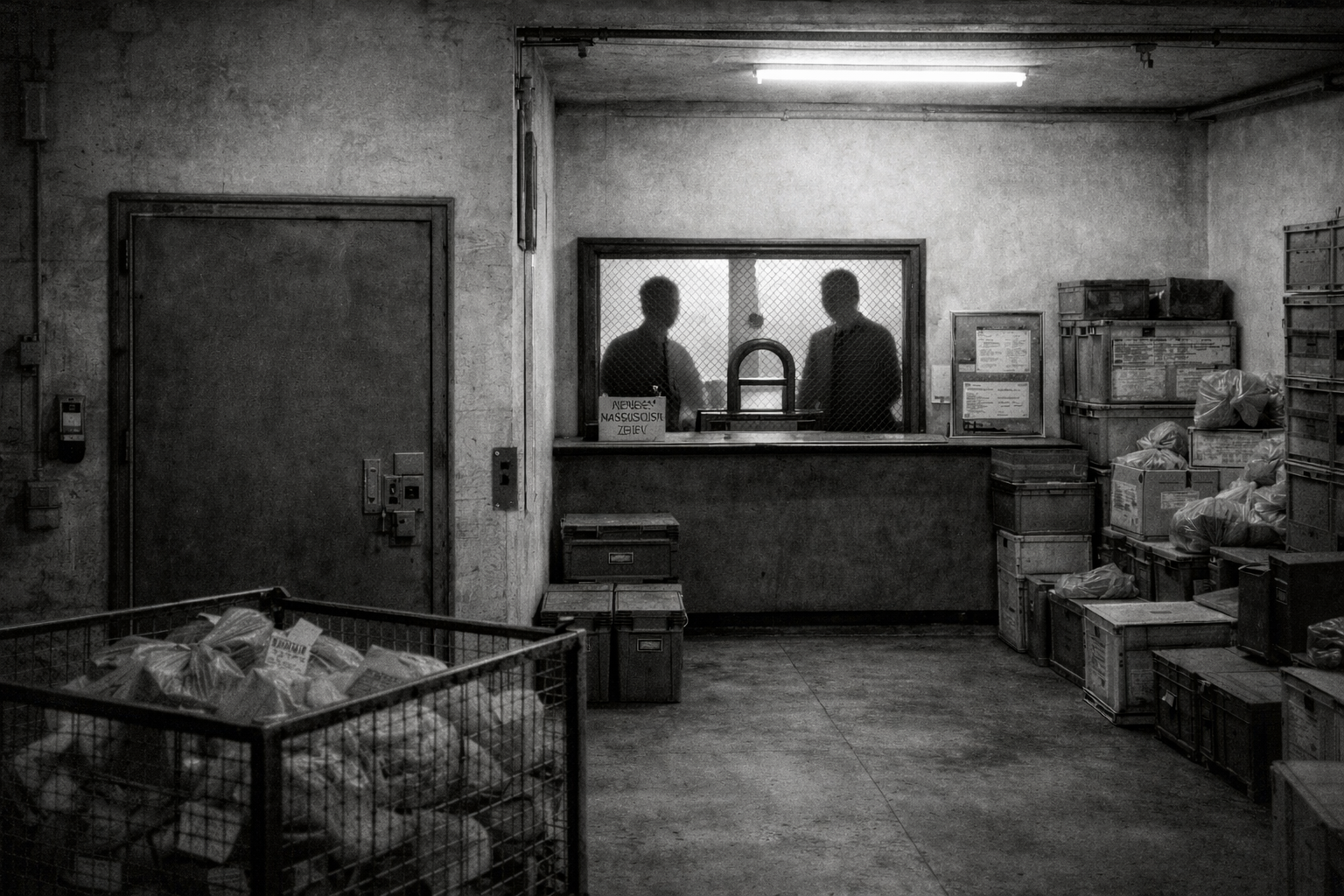
The door to Abteilung V – Verwertung und Sicherstellung—Section V – Disposal & Securing—didn’t have a sign.
It didn’t need one. Everyone in the building knew where it was, the way you knew where a drain was in a floor: not by markings, but by habit and by what happened if you ignored it.
I held the box against my ribs as I approached the reader. The corridor down here was narrower, the air warmer, dustier. It smelled of paper and hot machinery, the way old offices smelled when the windows hadn’t been opened in years. The lights were fluorescent, but older than the ones upstairs; they hummed faintly, as if the building itself were tired.
The card reader waited. A second lock sat beneath it, mechanical, unashamedly physical.
I swiped my Reichsbürgerkarte and listened for the sound.
PIEP.
Green.
The lock clicked open with a small, satisfied noise. I stepped through and pulled the door shut behind me.
There were no slogans here. No framed landscapes. No bust in a niche. Section V didn’t need reminders. It had function.
A short corridor led to a counter with a glass window and a narrow slot cut into the metal like a mouth. Behind it sat a man in a gray shirt with sleeves rolled to the elbows. He had the calm face of someone who had learned to be bored by things other people feared.
He didn’t look at me. He looked at the box.
“Transfer?” he asked.
“Yes,” I said, and heard my own voice come out too formal, as if I were speaking in a courtroom.
He pushed a metal tray through the slot. “Place the items. One at a time.”
I opened the box. The files inside were still in the order I had forced on them—barcodes aligned, edges squared, paper made to behave. The Mauthausen label stared back up at me from the cardboard, the wrongness of it now contained within procedure.
I lifted the first folder, slid it into the tray, and pushed it toward him.
He scanned the barcode without lifting his eyes.
PIEP.
A second scanner beeped somewhere behind him, answered by another.
Four-eyes. Two points in the chain. The act divided until no hand could claim it.
“Next.”
I fed him the second folder. Then the third.
PIEP.
PIEP.
PIEP.
The sound was oddly comforting. Each beep meant the chain was intact. Each beep meant my part was being converted into something the system could file away.
He paused on the fourth item. Not long. Not dramatically. Just long enough for me to notice.
He tilted the folder slightly, reading something I couldn’t see, then typed into a terminal below the counter.
The screen on my side was small and angled, meant for me to confirm the transfer. It showed nothing but codes and statuses.
VORGANG: ÜBERGABE
STATUS: PRÜFUNG
Case: handover. Status: review.
He scanned.
PIEP.
The status changed.
VERWERTUNG
Disposal.
Then, on the next line, it changed again—so quickly I almost thought I’d imagined it.
SICHERSTELLUNG
Securing.
I blinked. Sicherstellung was not an ending. It was custody. I did not think the next word—why—because why was not an approved field.
The clerk’s face didn’t move. His hand didn’t hesitate. He simply reached down and stamped the accompanying slip.
The stamp hit the paper with a dull thud that I felt in my fingertips even from this side of the glass.
He slid the stamped receipt back through the slot.
“Sign,” he said.
I signed where the line indicated. My name looked too personal on the form. I preferred barcodes.
When I handed it back, he tore off the lower strip and pushed it to me: my copy.
On it, in clean black print, was the same thing the screen had shown.
ÜBERGABE BESTÄTIGT.
VERWERTUNG: 6
SICHERSTELLUNG: 1
Handover confirmed. Disposal: 6. Securing: 1.
The numbers were ordinary. That was the problem. Six. One. Not a question, not an explanation, just a distribution.
I opened my mouth, then closed it.
There were questions that never made it out of your throat in this building. Some fall silent before they reach language.
The clerk had already turned to the next tray. Behind him, through another window, I could see the outline of a machine: rollers, a chute, a sign with a warning triangle. I couldn’t see what went into it. I couldn’t see what came out.
I folded the receipt twice and put it in my wallet, behind my identification papers, where it would lie flat and safe. Proof that I had done my part. Proof that my part had ended.
I carried the now-empty box back into the corridor. The door shut behind me with that same small click, the sound of a system sealing itself.
I climbed the service stairs without stopping. Past the conversion rooms where old paper became barcodes, past the intermediate storage cages, past doors that required readers and second locks, up into the clean air of the upper floors where the slogans waited to reassure you that everything made sense.
By the time I reached the processing floor again, my hands were steady.
They had to be. There was still work to do.
But the receipt in my wallet felt heavier than paper had any right to feel.
At 17:21 my terminal logged my last entry. The system accepted it. Green confirmation, like a small mercy.
I shut the terminal down, gathered my things, and joined the end-of-day flow toward the exit. The building released people the way it admitted them: by permission, by procedure.
At the gates I swiped my Reichsbürgerkarte again.
PIEP.
AUSGANG: GEWÄHRT.
Exit: granted.
Outside, Vienna struck me with its normality.
The air was colder than the building’s regulated breath. Trams glided past Schottentor in clean lines. Students moved in clusters near the university, their scarves bright, their laughter contained but real. A vendor sold roasted chestnuts, and the smell made the street feel like a city rather than an administrative diagram.
Posters on the street lamps framed the sidewalk like narrow walls.
One showed a smiling family outside a museum, the caption crisp and bright:
ZUVERLÄSSIGKEIT IST BÜRGERPFLICHT.
Reliability is civic duty.
Below it, smaller, official:
SZI – Monatsnachweis erforderlich.
SZI – Monthly verification required.
Another poster advertised a lecture series in an approved hall—history presented in clean, safe rectangles of meaning. Attendance would be scanned at the door. Points would be added. Reliability would be proven.
I walked toward the metro entrance, watching people move as if the streets belonged to them. Down in the station, a woman in a wool coat drew her card through the slot at the barrier without breaking stride. A man with a briefcase did the same. A teenager hesitated, fumbled, tried again—his cheeks flushing—and the reader chirped on the second attempt. He looked around immediately, as if to see whether anyone had noticed his delay.
I understood the instinct. Delays were data.
My turn.
PIEP.
The machine didn’t care that I was tired, or that my wallet held a receipt with a number that didn’t belong. It cared that I was valid. That I was kartenfähig.
I stepped onto the train as the doors chimed and closed, and found a seat by the window.
The tunnel took the city for a moment, then released it again in bright slices between stations—stone and light and people pretending, just for a moment, that the world was only what it looked like.
In the reflection on the glass, my face floated over Vienna like a watermark.
The paper in my wallet said: VERWERTUNG: 6. SICHERSTELLUNG: 1.
One file had been kept.